Islamic Seville is the city of Ishbiliya, capital of the Almohads in al-Andalus, and its heritage is still in plain sight: the Giralda was the minaret of the great mosque, the Patio de los Naranjos was its ablutions courtyard and the Torre del Oro guarded its river. The Real Alcázar adds a second story, Mudéjar art made for a Christian king by craftsmen trained in the Islamic tradition. This guide explains what you are looking at and how to see it in one or two days.
Ishbiliya: Seville in al-Andalus
Seville was an important city of al-Andalus from the 8th century. Abd al-Rahman III built a fortified enclosure there in 913-914, on the site of today’s Alcázar, and in the 11th century the Abbadid rulers of the taifa of Seville, among them the poet-king al-Mu’tamid, made it one of the most brilliant courts of the period, with a palace called al-Mubarak.
The great age of Islamic Seville came with the Almohads, the Berber dynasty from the Maghreb. They took the city in 1147 and from 1163 Seville became their seat in al-Andalus. Caliph Abu Ya’qub Yusuf made the Alcázar his main residence and ordered a new great mosque in 1171-1172; Friday prayer began there in 1182. His son Abu Yusuf Ya’qub al-Mansur completed the minaret. Islamic rule ended after a long siege, when Ferdinand III of Castile entered the city on 22 December 1248, and the mosque was soon converted into the city’s cathedral.
The Giralda: the Almohad minaret
The Giralda is the most visible Islamic monument in Spain. Work on the minaret was ordered in 1184, stopped when both the caliph and the first architect, Ahmad ibn Baso, died that year, and restarted in 1188. Ali al-Ghumari, a Maghrebi master builder, raised the brick body and its decoration, and the tower was completed on 10 March 1198, crowned with four metal spheres celebrating al-Mansur’s victory at Alarcos over Alfonso VIII of Castile.
Look at the façades: the large panels of interlaced lozenge decoration, known as sebka, are a signature of Almohad art and have close relatives in the Kutubiyya minaret of Marrakech and the Hassan Tower of Rabat. Inside, instead of stairs, there are 35 ramps, wide enough, a chronicler wrote, for people and beasts of burden. You still climb the Giralda by those ramps today, and the view over the city from the top is one of the best in Seville.
The spheres fell in an earthquake in 1356. Between 1558 and 1568 Hernán Ruiz the Younger added the Renaissance bell chamber, topped by the bronze weather vane called the Giraldillo, which gave the tower its name. The result is a tower of around 95 metres: Almohad up to the bells, Christian above.
The Patio de los Naranjos: the mosque’s courtyard
When you enter the cathedral complex, the courtyard of orange trees is the sahn of the Almohad mosque. According to the cathedral itself, the upper basin of the central fountain corresponds to the original fountain where worshippers made wudu before prayer. Part of the arcades with pointed horseshoe arches survives, as does the great cistern under the courtyard.
Leave the courtyard by the Puerta del Perdón, the old main entrance on the north side. Its bronze-plated doors with geometric patterns are Almohad; the knockers in place are replicas, and the originals are kept inside. Practical details and tickets are on the official Seville Cathedral website.
The Torre del Oro by the river
On the bank of the Guadalquivir stands the Torre del Oro, the “Tower of Gold”. It was built in 1220-1221 by order of the Almohad governor of Seville, Abu l-Ula, as a twelve-sided military watchtower controlling access to the city by river. It was one of the anchor points of a great chain that could be stretched across the river to block it. The tower has been altered over the centuries: the small cylindrical top was added in 1760, after the Lisbon earthquake of 1755, but the twelve-sided body is Almohad. Today it houses a small museum on navigation and the river, and the riverside walk to it is pleasant at sunset.
The Real Alcázar: Almohad and Mudéjar, side by side
The Real Alcázar is still a working royal palace: its upper floors are used by the Spanish royal family when they visit Seville. Together with the cathedral and the Archive of the Indies, it has been a UNESCO World Heritage Site since 1987. To enjoy it, you need one key distinction.
Almohad: Islamic art under Muslim rule
Almohad work was built for Muslim rulers before 1248. In the Alcázar it survives in parts of the walls around the Patio del León, in the sunken garden of the Patio del Crucero and in the remains of the Patio del Yeso. The style is restrained: brick, plaster, sebka panels and lobed arches, with little colour. The Giralda belongs to the same art.
Mudéjar: Islamic style for Christian patrons
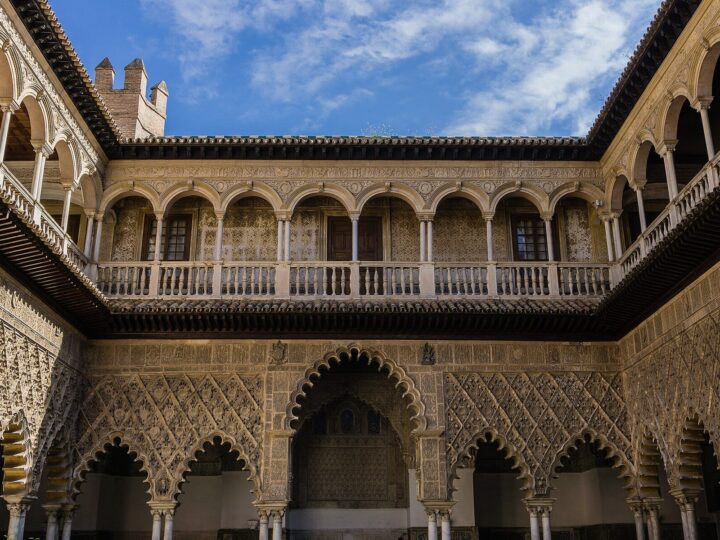
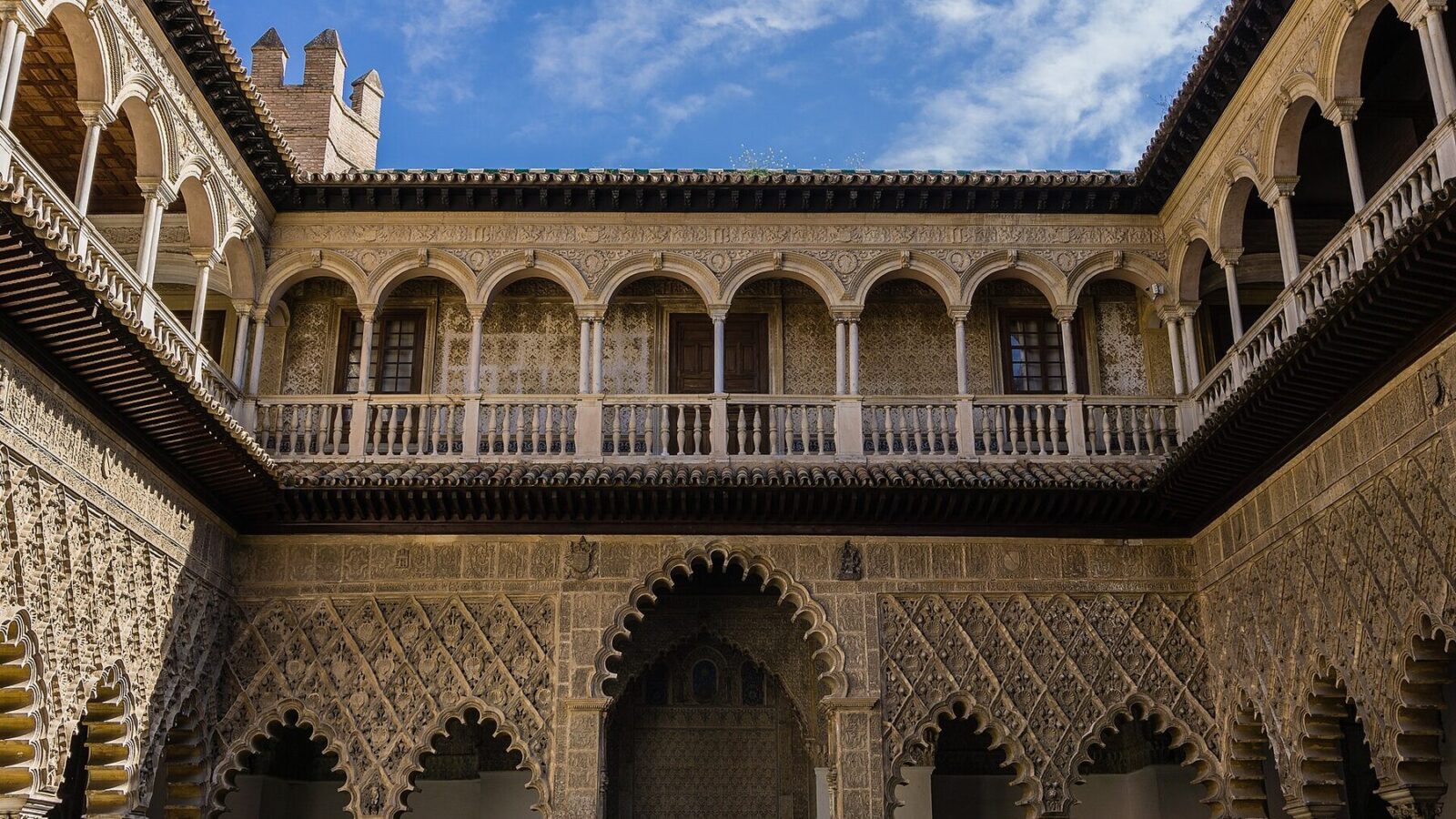
The word Mudéjar comes from the Arabic mudajjan and referred to Muslims who remained under Christian rule. Mudéjar art is the style that grew from this: Islamic decoration (geometric tilework, carved plaster, wooden ceilings, Arabic calligraphy) in buildings commissioned by Christian kings and nobles. The Palace of Pedro I, built in 1364-1366, is its masterpiece. Pedro I of Castile was an ally of Muhammad V of Granada, and craftsmen from Granada, Toledo and Seville worked on it, which is why parts feel so close to the Alhambra.
Read the walls of the Patio de las Doncellas and the Hall of Ambassadors: some Arabic inscriptions praise Pedro himself, calling him “sultan”. It is a Christian king’s palace, written in the visual language of al-Andalus.
In short: the Giralda and the Patio del Yeso are Islamic monuments of Ishbiliya; Pedro I’s palace is Christian architecture made in an Islamic style, about a century after the city changed hands.
A one- or two-day route through Islamic Seville
Day 1: the Almohad heart. Start early at the cathedral and climb the Giralda by its ramps, then spend time in the Patio de los Naranjos and leave by the Puerta del Perdón. After lunch, visit the Real Alcázar. Tickets have timed entry and sell out in busy seasons, so book ahead. End the day walking through the narrow lanes of the Santa Cruz quarter next door.
Day 2: the river and the walls. Walk along the Guadalquivir to the Torre del Oro. In the afternoon, head north to the Macarena district to see the best-preserved stretch of the medieval city walls, between the Macarena Arch and the Cordoba Gate, built in the 12th century when Seville was a Muslim city. If you have time, return to the Alcázar gardens or cross the river to the Triana district.
With only one day, combine the cathedral, the Giralda and the Alcázar, and see the Torre del Oro on an evening walk. Seville is part of our Golden Triangle tour with Cordoba and Granada, and of the eight-day Al-Andalus Grand Tour. For prayer and food on the road, see our halal travel guide.
Frequently asked questions
Was the Giralda a minaret?
Yes. It was the minaret of the Almohad great mosque of Seville, begun in 1184 and completed in 1198. The bell chamber on top was added in the 16th century.
What is the difference between Almohad and Mudéjar?
Almohad art was built for Muslim rulers before 1248. Mudéjar art uses Islamic decoration in buildings made for Christian patrons after the conquest, like the Palace of Pedro I in the Alcázar.
How many days do I need for Islamic Seville?
One full day covers the Giralda, the Patio de los Naranjos and the Alcázar. Two days let you add the Torre del Oro, the walls and a slower pace.
Is the Alcázar of Seville Islamic?
Partly. It keeps Almohad walls, courtyards and gardens, but its most famous palace, that of Pedro I, is Mudéjar: built for a Christian king by craftsmen working in the Islamic tradition.
Seville rewards travellers who know what they are looking at. Tell us your dates and who is travelling, and we can plan Islamic Seville for you as a private or small-group tour, planned around prayer times. Our team speaks English and Arabic: contact us here, or read more about the history of al-Andalus.