Travel guides
Where to Pray in Andalusia: Mosques in Granada, Cordoba, Seville, Malaga and Marbella
Every major city in Andalusia has at least one active mosque, and Granada, Malaga and Marbella have purpose-built ones with minarets. Prayer times and Jumu’ah arrangements are set locally and change through the year, so confirm them on arrival. This guide lists the mosques we know to be active, and explains how to keep your prayers on a sightseeing day.
Granada: the Great Mosque in the Albaicin
The Great Mosque of Granada (Mezquita Mayor de Granada) stands in the Albaicin, the old Muslim quarter, right beside the Mirador de San Nicolás. Completed in 2003, it was the first mosque built in the city in around five centuries, and it holds daily prayers and Jumu’ah.
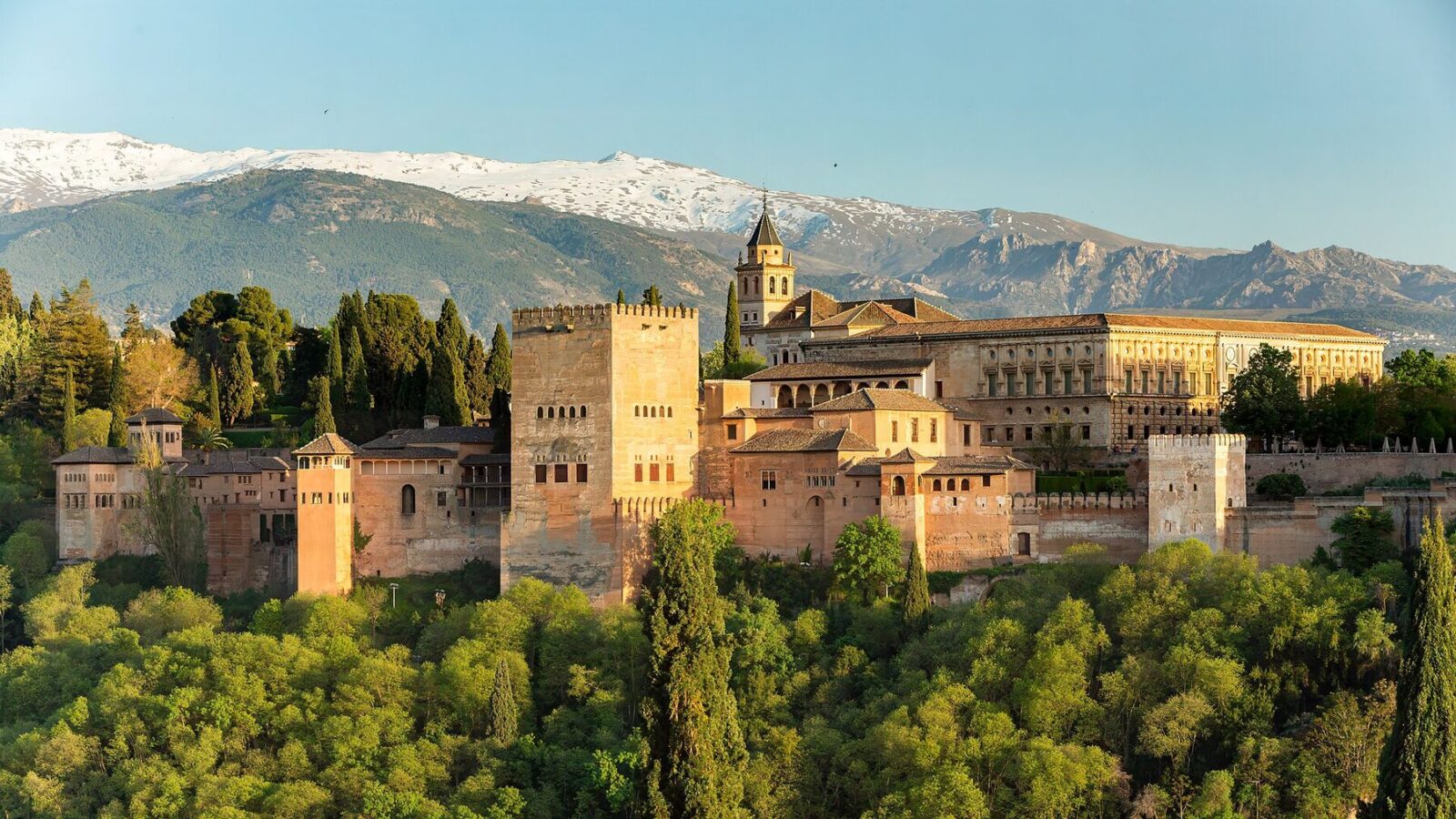
For visitors it is the most memorable place to pray in Spain. Its garden looks straight across the valley to the Alhambra, and praying Maghrib there as the palaces turn red is a moment many travellers never forget. The Albaicin is steep and cobbled, so allow time to walk up, or take a taxi or one of the small local buses. Our guide to visiting the Alhambra explains how to fit prayers around your ticket time.
Cordoba: the Al-Morabito Mosque
Islamic prayer is not permitted inside the Cordoba Mosque-Cathedral. The building is the city’s Catholic cathedral, and its rules restrict worship to Catholic services. Many Muslim visitors find this hard, so it helps to know before you go and to pray beforehand.
The best-known active mosque for visitors is the Al-Morabito Mosque (Mezquita Al-Morabito) in the Jardines de Colón, in the north of the historic centre and within walking distance of the old town. It is a small building with its own history: it was built in the twentieth century and reopened as a mosque for the local community in 1992. Our guide to the Cordoba Mosque-Cathedral for Muslim visitors has more on both.
Seville: the city-centre mosque and the Macarena
Seville does not yet have a large purpose-built mosque. The Fundación Mezquita de Sevilla runs a mosque in the city centre, with prayer rooms for men and women and Friday sermons, and publishes its prayer schedule on its website, mezquitadesevilla.com. The foundation is also working on a larger Islamic cultural centre with a mosque in the south of the city.
There is also a long-established mosque in the Macarena district, north of the old town. Beyond these, Seville has a number of smaller prayer rooms (musallas) in residential neighbourhoods. If you are only in the city for a day, the city-centre mosque is the practical choice. Our guide to Seville’s Islamic heritage covers what to see between prayers.
Malaga: the Mosque of Malaga
Malaga has a large purpose-built mosque, the Mosque of Malaga, also known as the al-Andalus Mosque (Mezquita de al-Ándalus). It sits outside the historic centre, a short taxi ride from the Alcazaba and the cathedral, and has a minaret, separate entrances for men and women and room for around a thousand worshippers. It is the main mosque for Muslim visitors to the city.
If you arrive at Malaga airport and head straight inland to Granada or Cordoba, this is a good place to stop for Dhuhr or Asr on the way, and to pray Jumu’ah if you land on a Friday.
Marbella: the King Abdul Aziz Mosque
The King Abdul Aziz Mosque, also called the Mosque of Marbella, opened in 1981 and was one of the first mosques built in Spain in modern times. It was funded from Saudi Arabia, holds around 800 worshippers, and stands on the western side of Marbella, towards the Golden Mile. With its white walls, garden and minaret, it is the best-known mosque on the Costa del Sol.
Many families from the Gulf and the UK spend summer on this stretch of coast, so Jumu’ah can be busy in July and August. Arrive early.
Friday prayer when you are travelling
- Check the time locally. The time of the khutbah and the prayer changes between winter and summer. Ask at the mosque the day before, look at its noticeboard or website, or ask us before your trip.
- Arrive early. Many mosques in Spain are smaller than mosques in the UK, and space fills quickly, especially in summer and during Ramadan.
- Expect Arabic and Spanish. Khutbahs are usually in Arabic, Spanish or both. English is uncommon.
- Women’s space. The mosques above have prayer space for women, but it can be smaller than the men’s. Sisters may want to ask in advance, particularly for Jumu’ah.
- Plan the day around it. In summer, Jumu’ah falls in the hottest part of the day. Build your sightseeing around it rather than squeezing it in between two monuments.
Praying while sightseeing
Most of your prayers on a trip will not be in a mosque. A few habits make it simple:
- Use a prayer app. A reliable prayer-times app with a qibla compass is essential. Set it to a calculation method you trust and check it against the local mosque timetable when you can.
- Know the qibla. From Andalusia the qibla is roughly east, slightly south of east. A phone compass works well, but keep it away from metal railings and car bodies.
- Plan around the monuments. There are no prayer rooms inside the Alhambra, the Alcázar of Seville or the Cordoba Mosque-Cathedral. Pray before you go in, and check your timed entry so it does not clash with a prayer.
- Parks and gardens. Many travellers pray discreetly in a quiet corner of a park or garden. Choose a calm spot away from paths, carry a light travel prayer mat, and be ready to keep it short.
- Your hotel or apartment. Pray Fajr and Isha where you are staying, and ask the hotel which way the qibla is; some will know.
- Long summer days. In June and July, Fajr is very early and Isha very late, with Maghrib after 9 pm. Plan rest in the afternoon, as Spanish families do.
- Travelling and combining. Many scholars allow travellers to shorten and combine prayers. Follow the opinion of your own madhhab or scholar.
Wudu is easiest at your accommodation or at a mosque. Public toilets at monuments are usually clean, but a small water bottle in your bag helps.
Frequently asked questions
Can I pray inside the Cordoba Mosque-Cathedral or the Alhambra?
Not inside the Mosque-Cathedral, where only Catholic worship is allowed. The Alhambra has no prayer space; pray at the Great Mosque of Granada across the valley.
Which mosque in Andalusia is best for visitors?
The Great Mosque of Granada, for its location facing the Alhambra. Malaga and Marbella have the largest purpose-built mosques on the coast.
Are women welcome at mosques in Andalusia?
Yes. The mosques listed here have prayer space for women, though it is sometimes smaller than the men’s area.
Where can I find Jumu’ah times?
Ask at the mosque, check its noticeboard or website, or ask us. We do not publish fixed times because they change through the year.
A trip to al-Andalus is easier when the day is planned around your prayers. Our Golden Triangle tour and Granada and Alhambra tour can be arranged as private or small-group tours, and you can read how we approach food and prayer on our halal travel page. Our team speaks English and Arabic: tell us your dates and we can plan this for you, in shaa Allah.