Madinat al-Zahra (Medina Azahara in Spanish) is the palace-city that Abd al-Rahman III built just west of Cordoba as the seat of his caliphate, begun around 936-940 and destroyed in the civil war that started in 1010. Today it is a UNESCO World Heritage Site that you visit by starting at the museum and taking a shuttle bus up to the ruins. Here is its story, how the visit works and how to combine it with the Cordoba Mosque-Cathedral in one day.
Abd al-Rahman III and the birth of a caliphate
In 929 Abd al-Rahman III, the Umayyad emir of Cordoba, took the title of caliph and Commander of the Faithful. It was a political statement: the Fatimids had proclaimed their own caliphate in North Africa, and the Umayyads of al-Andalus, heirs of the dynasty of Damascus, would not be outranked. A new caliphate needed a new capital that showed its power.
Work on Madinat al-Zahra began a few years later. Historians date the foundation to around 936, with the chronicles often giving 940 for the formal start of the city, and the court moved there in the following decade. The name means “the city of al-Zahra”. A popular story says it was named after a favourite wife of the caliph, but this is legend rather than proven history; “al-Zahra” can also be read as “the shining” or “the flourishing”.
The city was built in terraces on the lower slopes of the Sierra Morena, looking out over the Guadalquivir valley. At the top stood the caliph’s residence, below it the official buildings and reception halls with their gardens, and lower down the homes, workshops and the congregational mosque. Work continued under his son al-Hakam II, who also enlarged the Great Mosque of Cordoba and built its famous mihrab.
A court that received the world
For a few decades Madinat al-Zahra was one of the great courts of the Mediterranean. Ambassadors came from Byzantium and from the Christian kingdoms of Europe, and from North Africa. The reception halls, especially the hall known today as the Salon Rico (the Hall of Abd al-Rahman III), were decorated with carved stone panels of plant motifs that still impress visitors. Inscriptions name the craftsmen and the dates of the work.
The city also housed the mint, the state workshops and the administration of the caliphate. Ivory caskets, textiles and metalwork made for the court are now in museums around the world.
The fall: 1010 and after
The caliphate did not outlive its founders by long. After the death of al-Mansur and his sons, al-Andalus fell into a civil war known as the fitna. In 1010 Madinat al-Zahra was sacked, and over the following years it was looted and abandoned. For centuries its marble columns and carved stone were taken away and reused in other buildings, and the site was forgotten until excavations began in the early twentieth century.
Only part of the city has been excavated. What you see today is a mix of original remains and careful restoration, which is why the museum is so useful before you walk the site.
On 1 July 2018 UNESCO inscribed the “Caliphate City of Medina Azahara” on the World Heritage List, recognising it as the best-known example of an Islamic city of the Western caliphate.
How the visit works today: museum and shuttle bus
The site is managed by the regional government of Andalusia as the Conjunto Arqueologico de Madinat al-Zahra. The visit has two parts:
- The museum and visitor centre. This is where you arrive, park and get your bearings. The museum is built low into the ground so it does not compete with the ruins, and its exhibition explains the history of the city with objects from the excavations. Spend time here first; it makes the ruins much easier to read.
- The shuttle bus to the archaeological site. The ruins are about two kilometres from the museum, and private cars cannot drive up to them. A shuttle bus runs between the museum and the site during opening hours, leaving regularly, roughly every 15 to 20 minutes. The last shuttle up leaves some time before closing, so do not arrive late. The shuttle has a small separate fare; bring some cash in case card payment is not available.
To get from Cordoba to the museum you can drive (it is a short trip west of the city), take a taxi, join a guided tour or use the tourist bus that leaves from the Paseo de la Victoria in the city centre. That bus must be booked in advance, as tickets are not sold on board, and it does not run every day. The site itself closes on Mondays, with exceptions around public holidays.
Opening hours change between winter and summer, and in summer the site opens only in the morning. Check the current hours and conditions on the official Madinat al-Zahra website before you go.
A few practical points:
- Wear good shoes. Paths in the ruins are uneven and slope downhill through the terraces.
- There is little shade on the site, so bring water and a hat, especially from May to September.
- Allow two and a half to three hours for the museum, the shuttle and the ruins together.
- There is no mosque on site where you can pray, so plan your visit between prayer times and pray before you leave Cordoba.
What to look for at the site
Walking down from the upper terraces, look for the great arched portico that opened onto the parade ground, the remains of the residential quarters, and the area of the Salon Rico with its gardens and pools in front. Further down are the remains of the congregational mosque of the city, set at an angle to the other buildings so that it faces its qibla. For many Muslim visitors this is a moving spot: a mosque where the caliph and his court once prayed, now open to the sky.
Restoration works can close parts of the site from time to time, so ask at the museum what is open on the day of your visit.
Combining Madinat al-Zahra and the Mosque-Cathedral in one day
It is possible to see both in a single day, and they tell one story: the Mezquita shows the religious heart of Umayyad Cordoba, and Madinat al-Zahra its political ambition. Our suggested order:
- Morning: Madinat al-Zahra. Go early, when it is cooler and quieter, and start at the museum.
- Lunch and rest in Cordoba. Head back to the city for lunch and Dhuhr prayer.
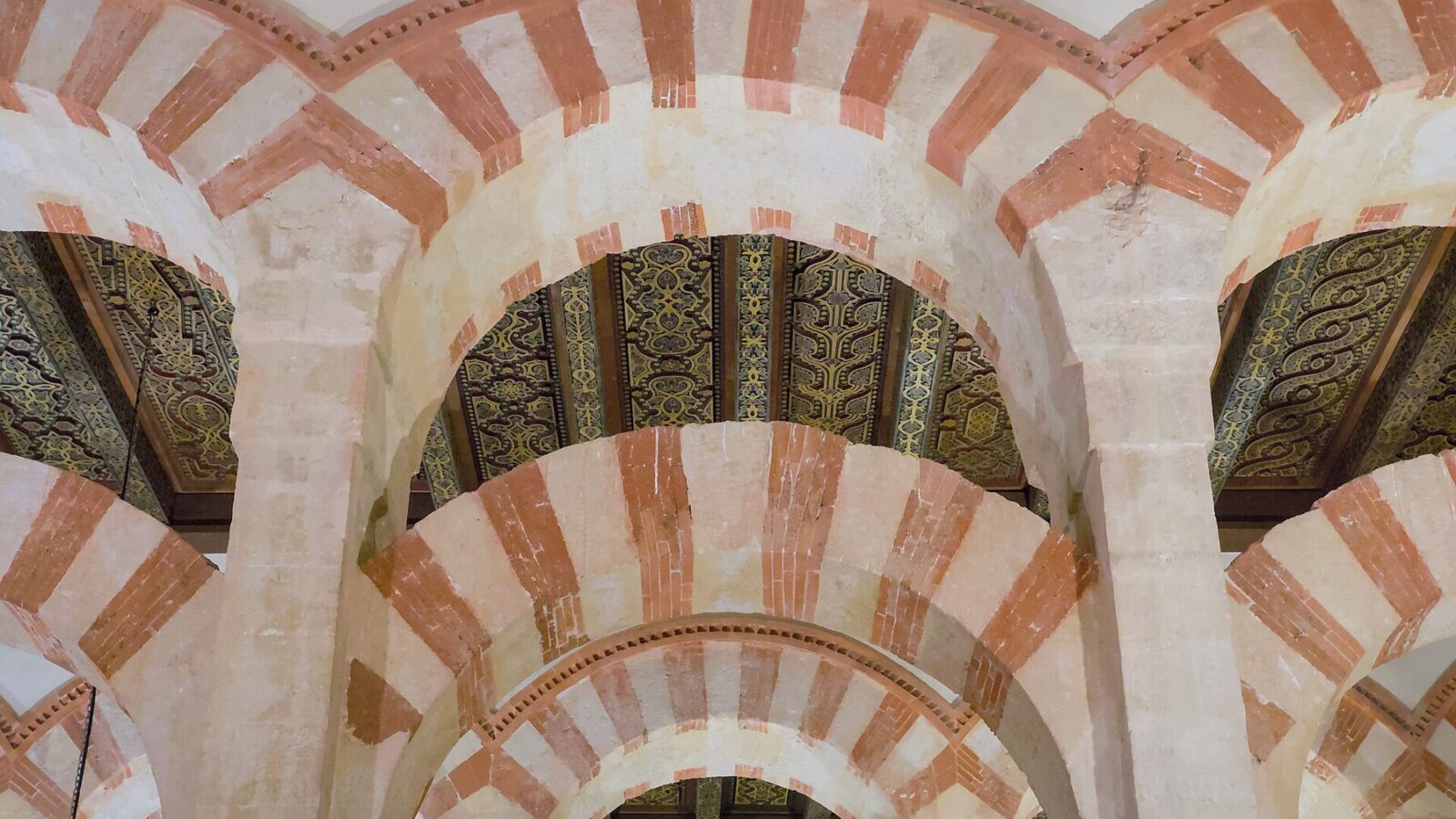
- Afternoon: the Mosque-Cathedral. Walk through the forest of arches to the mihrab of al-Hakam II, built by the son of the caliph whose city you saw in the morning. Read our guide to the Cordoba Mosque-Cathedral for Muslim visitors for its history, the prayer rule inside and where to pray in Cordoba.
- Evening: the old town. End with a walk across the Roman bridge at sunset.
This works best from Tuesday to Sunday, because Madinat al-Zahra is closed on Mondays. If you prefer not to rush, give Cordoba two days.
Visiting with us
Our Cordoba of the Caliphs tour covers the Mosque-Cathedral and Madinat al-Zahra over two days, with transport arranged so you do not need to worry about the bus. Madinat al-Zahra is also part of the Al-Andalus Grand Tour, which continues to Seville, Ronda and Granada.
Frequently asked questions
Who built Madinat al-Zahra?
Abd al-Rahman III, the first caliph of Cordoba, began it around 936-940. His son al-Hakam II continued the work.
When was Madinat al-Zahra destroyed?
It was sacked in 1010 during the civil war (fitna) that ended the Caliphate of Cordoba, then looted and abandoned over the following years.
Can I drive to the ruins?
You can drive to the museum and park there, but the archaeological site itself is reached by the shuttle bus that leaves from the museum.
Is it a UNESCO World Heritage Site?
Yes. UNESCO inscribed the Caliphate City of Medina Azahara in 2018.
Standing on the terraces of Madinat al-Zahra, looking down over the valley the caliphs once ruled, is one of the most powerful moments of any trip to al-Andalus. Tell us your dates through our contact page and we can plan your days in Cordoba, as a private or small-group tour.