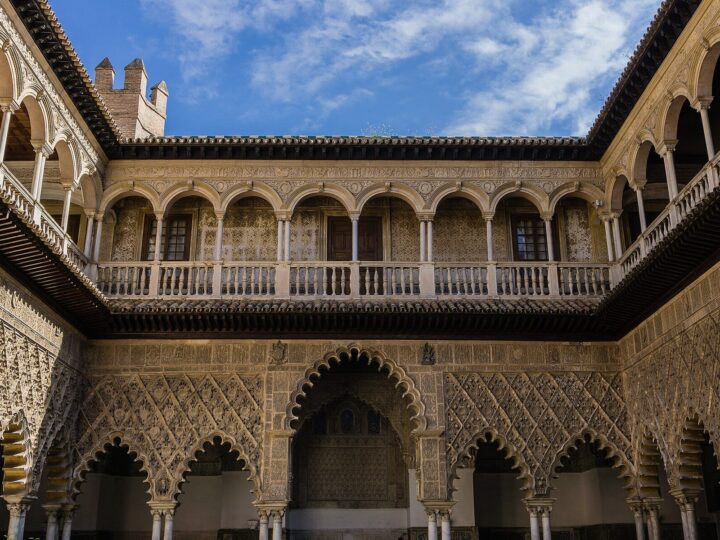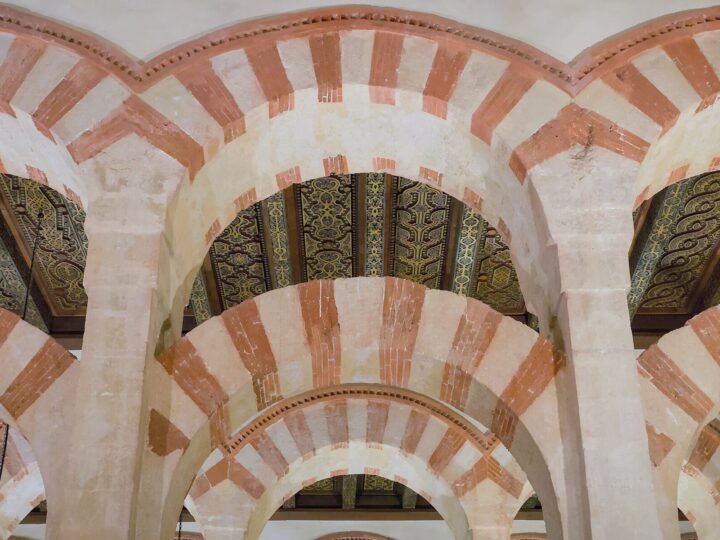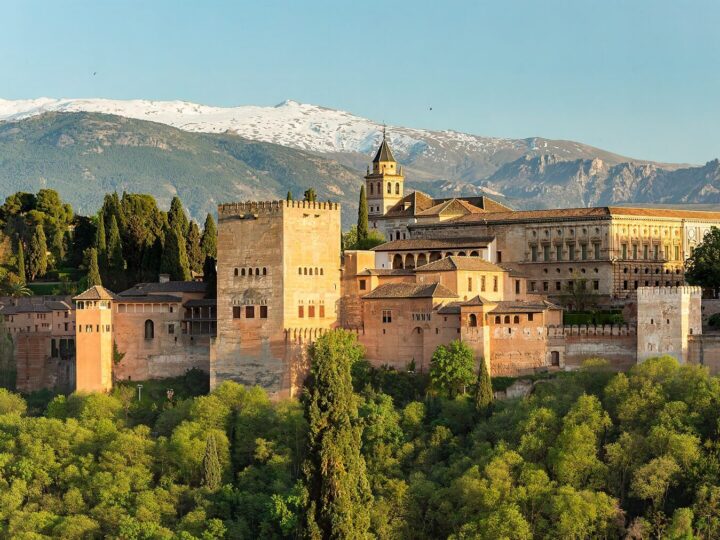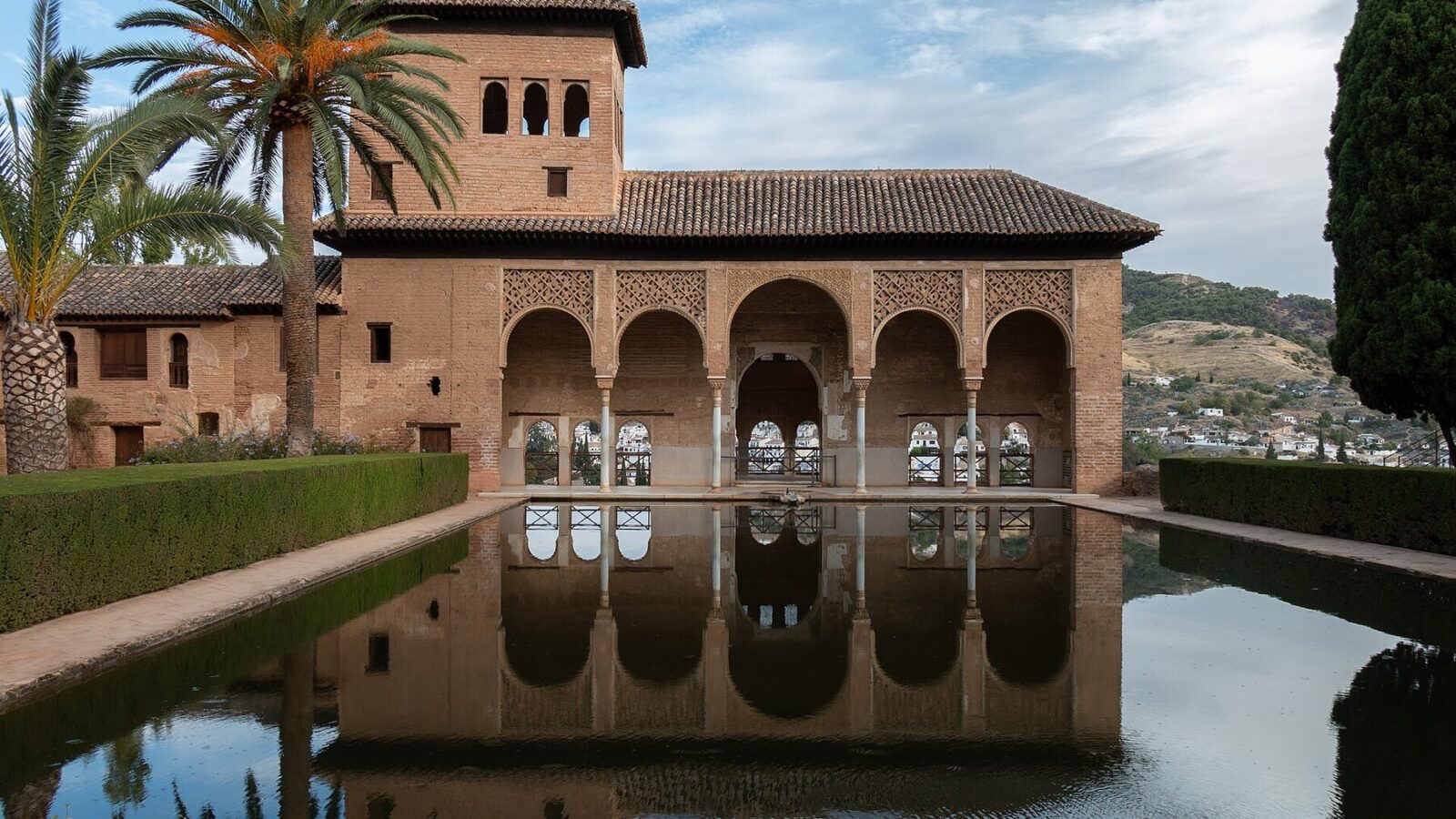
Visiting the Alhambra is, for many Muslims, the emotional high point of a trip to Spain: it is the last great palace city of al-Andalus, and its walls still carry the words wa la ghaliba illa Allah. To enjoy it properly you need three things: a little history, a ticket booked well in advance with a fixed time for the Nasrid Palaces, and a plan for your prayers, which is easiest at the Great Mosque of Granada in the Albaicin, just across the valley.
The Nasrids: the last Muslim kingdom of al-Andalus
By the thirteenth century most of al-Andalus had passed into Christian hands. In 1238 Muhammad I, known as Ibn al-Ahmar, established the Nasrid dynasty in Granada, and for more than two and a half centuries the Emirate of Granada was the last Muslim state on the Iberian Peninsula. On the red hill above the city, the Sabika, the Nasrids built a fortified palace city: the Alhambra, from the Arabic al-Qal’a al-Hamra, “the red fortress”.
The palaces you visit today were built and decorated mostly in the fourteenth century, the golden age of the dynasty, under sultans such as Yusuf I and Muhammad V. The kingdom came to an end when Granada was surrendered to the Catholic Monarchs in January 1492. Today the Alhambra is one of the most visited monuments in Spain and a UNESCO World Heritage Site together with the Generalife and the Albaicin.
If you want the wider story, from the arrival of Islam in 711 to the fall of Granada, read our page on the history of al-Andalus before you go.
“Wa la ghaliba illa Allah”: the motto on every wall
Look closely at the plasterwork, the tiles and the carved wood and you will see one Arabic phrase repeated again and again: لا غالب إلا الله, wa la ghaliba illa Allah, “and there is no victor but Allah”. It was the motto of the Nasrid dynasty, and the Alhambra’s own heritage body notes that it accounts for a large share of all the inscriptions inside the walls.
A well-known story links it to a Nasrid ruler who returned to Granada after helping the Castilians at the siege of Seville. The crowds greeted him as “the victor”, and he answered that there is no victor except Allah. Historians debate the details, and some trace the phrase back to the Almohads. For a Muslim visitor it changes how you see the place: these are not only beautiful rooms, but walls covered in remembrance of Allah, alongside Qur’anic verses and the poetry of the Nasrid court.
What to see: Nasrid Palaces, Alcazaba and Generalife
The Nasrid Palaces
The heart of the visit and the part everyone wants to see. You pass through the Mexuar, where the sultan’s council met, into the Comares Palace with the Court of the Myrtles and its long reflecting pool, and the Hall of the Ambassadors, the throne room under a carved wooden dome representing the heavens. From there you enter the Palace of the Lions, built under Muhammad V, with its courtyard of slender columns and the fountain of twelve lions, and the halls around it with their honeycomb muqarnas ceilings. This is the only area with a fixed entry time printed on your ticket.
The Alcazaba
The military fortress at the western tip of the hill and the oldest part of the complex. Climb the Torre de la Vela for one of the best views over Granada, the Albaicin and, on clear days, the Sierra Nevada.
The Generalife
The summer estate of the Nasrid sultans, set slightly apart from the palaces, with terraced gardens, orchards and water channels. The Court of the Water Channel (Patio de la Acequia) is the best-known view.
How and when to buy Alhambra tickets
This is where most trips go wrong. Visitor numbers are limited every day and tickets regularly sell out, especially in spring, during Spanish holidays and at weekends. Some practical rules:
- Book as early as you can. Once your dates are fixed, buy your tickets. Waiting until you arrive in Granada usually means no Nasrid Palaces.
- Use the official channel. Buy from the official website of the Patronato de la Alhambra y Generalife (alhambra-patronato.es) or through an authorised guided tour. Be careful with resellers that charge much more for the same ticket.
- Choose your Nasrid Palaces time carefully. The general ticket gives access to the whole monument, but the Nasrid Palaces can only be entered in the time slot shown on the ticket. If you miss it, you should not expect to be let in later. The palaces are a fair walk from the main entrance, so arrive early.
- Bring your ID or passport. Tickets are issued in each visitor’s name, and the name must match the document you carry.
- If the general ticket is sold out, check the other options on the official site, such as the gardens ticket (without the Nasrid Palaces), night visits or a guided tour that includes entry.
When choosing your time slot, think about prayer times. A morning slot leaves the afternoon free for the Albaicin and the mosque; in winter, when the days are short, Dhuhr and Asr come close together, so plan around them. During Ramadan, an early slot before the afternoon heat is usually easier on those fasting.
On our Granada and Alhambra tour we take care of the tickets and timing for you, which removes most of the stress.
Where to pray near the Alhambra
There is no mosque inside the Alhambra, so plan your prayers around the visit. The obvious place is the Great Mosque of Granada (Mezquita Mayor de Granada) in the Albaicin, the old Muslim quarter facing the Alhambra. It was completed in 2003, the first mosque built in Granada in around five centuries, and holds daily prayers and Jumu’ah.
The mosque stands right beside the Mirador de San Nicolás, the famous viewpoint where visitors gather to watch the Alhambra at sunset. Its garden looks straight across to the palaces, and visitors can enter the garden. Praying Maghrib there, with the Alhambra turning red and gold opposite you, is something many of our travellers describe as the moment of the trip.
Some practical notes:
- The Albaicin is steep, with narrow cobbled streets. Comfortable shoes matter, and a taxi or the small local buses help older travellers.
- For Friday prayer, check the khutbah time with the mosque locally, as it can change through the year.
Tips for families and women travellers
- Dress: modest clothing is no problem at all, and hijab and abaya are common sights in Granada. Choose light layers in summer, as there is little shade in the gardens at midday.
- Children: the visit involves a lot of walking. Plan breaks in the Generalife gardens and carry water.
- Food: there is little halal food on the hill itself. Eat before or after in the city centre or the Albaicin; our guide to halal travel in Spain explains how.
Frequently asked questions
How long does it take to visit the Alhambra?
Allow at least three to four hours for the Nasrid Palaces, Alcazaba and Generalife together. Add time for the Albaicin and the mosque on the same day.
Can I buy Alhambra tickets on the day?
Sometimes, but do not count on it. Tickets for the Nasrid Palaces often sell out well in advance, so book as soon as your dates are confirmed.
Is there a place to pray inside the Alhambra?
No. The nearest mosque is the Great Mosque of Granada in the Albaicin, next to the Mirador de San Nicolás.
Is the Alhambra suitable for a Muslim family trip?
Very much so. It is one of the most meaningful places in Europe for Muslim visitors, and Granada is used to welcoming families from the Muslim world.
Visiting the Alhambra is often the start of a deeper journey through al-Andalus. If you would like to combine it with Cordoba and Seville, look at our Golden Triangle tour or the full Al-Andalus Grand Tour, both available as private or small-group tours. Our team speaks English and Arabic: tell us your dates and we can plan this for you, in shaa Allah.